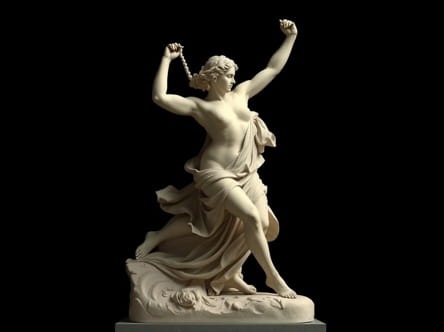
Giambologna’s Abduction of a Sabine Woman is widely regarded as one of the greatest masterpieces of late Renaissance sculpture. Created in the late 16th century, the dynamic marble composition showcases the artist’s technical brilliance and innovative approach to representing human emotion and movement in stone. Located in the Loggia dei Lanzi in Florence, this powerful group sculpture captures the intensity of a moment steeped in mythological and historical symbolism. It stands not only as an iconic artistic achievement but also as a testimony to the era’s cultural and political values, as well as Giambologna’s role in shaping Mannerist sculpture in Europe.
Historical Context and Commission
Giambologna and the Medici Patronage
Giambologna, born Jean de Boulogne in Flanders, moved to Italy to study classical and Renaissance art. He eventually settled in Florence, where he became a favored court sculptor for the powerful Medici family. The Abduction of a Sabine Woman was commissioned by Francesco I de’ Medici in the 1570s, not for a specific mythological program but as a demonstration of the sculptor’s skill.
The work was not initially intended to depict the Roman myth of the Sabine women, but after its completion, the title was ascribed to it due to the resemblance to the famous episode from Roman legend. This approach was not uncommon in Mannerist art, where form and artistic expression often took precedence over strict narrative content.
The Legend of the Sabine Women
The historical reference behind the sculpture comes from the early legends of Rome, particularly the tale where Roman men abducted women from the neighboring Sabine tribe in order to secure wives for the fledgling Roman population. This moment of cultural clash and forced union has been depicted in many forms of classical and Renaissance art, symbolizing both conflict and the eventual merging of civilizations.
Artistic Composition and Design
Multi-Figure Structure
The sculpture is composed of three figures stacked in a vertical spiral: an older man crouching at the base, a younger man lifting a woman above him, and the woman reaching upward in distress. The lack of a singular viewing angle was revolutionary at the time. Viewers are encouraged to walk around the sculpture to grasp its full emotional and compositional impact.
- The elderly manrepresents defeat and helplessness, possibly symbolizing the conquered Sabine tribe.
- The young manis full of energy and motion, exemplifying the aggressor, possibly a Roman figure.
- The womanis caught in a moment of terror and resistance, dramatically twisted as she reaches for help or freedom.
Each figure contributes emotionally and physically to the overall narrative. The sculpture’s verticality and tension are enhanced by the muscular detail, flowing drapery, and naturalistic anatomy that characterize Giambologna’s work.
Marble and Technique
Carved from a single block of white marble, the Abduction of a Sabine Woman is a technical marvel. Giambologna’s decision to create such a complex, intertwined composition in one piece of stone demonstrates his exceptional understanding of form and structure. He combined classical ideals of proportion with Mannerist expressiveness, pushing the boundaries of what could be achieved in marble sculpture.
Innovations and Artistic Influence
Visual Movement and Emotional Drama
Unlike the more restrained classical sculptures of earlier periods, this work is known for its twisting, serpentine composition an embodiment of the figura serpentinata, a style favored during the Mannerist period. This technique gives the sculpture a sense of motion and allows the viewer to experience a sequence of emotions from every angle.
Giambologna’s focus on visual drama over narrative clarity marked a shift in sculptural priorities. His ability to depict intense psychological and physical struggle within a harmonious structure set new standards for European sculpture during the late Renaissance.
Impact on Later Artists
The Abduction of a Sabine Woman greatly influenced subsequent sculptors, including Gian Lorenzo Bernini, who expanded upon Giambologna’s dynamic compositions in the Baroque period. The sculpture’s spiraling form and emotional depth set the stage for a new era of expressive realism in sculpture that would dominate Italian and European art for generations.
Placement and Public Display
Location in the Loggia dei Lanzi
The statue was installed in the Loggia dei Lanzi in Florence’s Piazza della Signoria, an open-air museum that served as a political and artistic showcase for the city. Its public placement allowed people from all walks of life to encounter and admire the work, a testament to the Medici’s desire to use art as a tool of both cultural and political power.
Its location among other famous sculptures, including Cellini’s Perseus with the Head of Medusa and Donatello’s Judith and Holofernes, places it in direct dialogue with other masterpieces of Florentine sculpture, creating a visual narrative of power, violence, and myth.
Symbolism and Interpretation
Allegorical Layers
Though the title Abduction of a Sabine Woman was applied after the sculpture’s completion, it adds rich layers of interpretation. On one level, it illustrates the Roman myth, a tale of foundation through force and integration. On another, it can be viewed as an allegory of human struggle youth overpowering age, passion over reason, chaos over order.
Art historians have also suggested that the figures symbolize the passage of time or the three stages of life youth, maturity, and old age each stacked upon the other in a dramatic representation of human experience. The ambiguity of the narrative opens space for diverse interpretations, one of the defining traits of Mannerist art.
Legacy and Enduring Fame
Giambologna’s Masterpiece
Today, the Abduction of a Sabine Woman is considered Giambologna’s greatest work. It represents the height of his artistic career and solidifies his place among the giants of Renaissance sculpture. His combination of technical perfection and expressive design set a benchmark for future sculptors.
Continued Admiration
The sculpture continues to attract art lovers, students, and scholars from around the world. Its placement in the heart of Florence ensures that it remains not only a masterpiece of art history but also a living part of the city’s cultural identity. Museums, books, and academic studies frequently highlight this work as an example of Renaissance genius and artistic bravery.
Giambologna’s Abduction of a Sabine Woman is far more than a mythological depiction it is a celebration of sculptural ambition, emotional storytelling, and artistic mastery. Its breathtaking design, dramatic movement, and symbolic complexity make it a timeless work that continues to inspire awe. As both a public monument and a work of private genius, it bridges the realms of myth, history, and artistry in a way that few sculptures have ever done. It stands as a testament not only to one artist’s vision but also to the power of sculpture to capture the full range of human emotion and form.