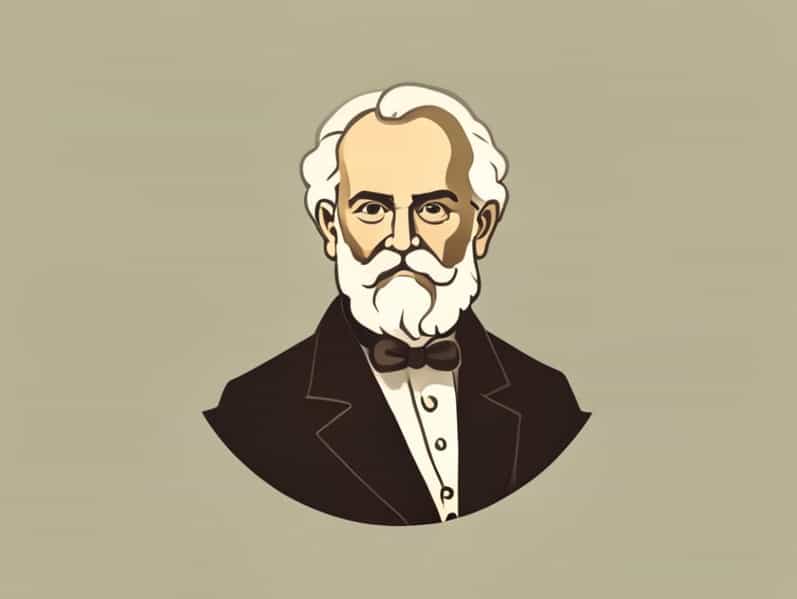
Gregor Mendel is often remembered as the Father of Genetics, but behind this scientific title lies a fascinating story of curiosity, patience, and discovery. His experiments with pea plants forever changed how we understand heredity and biological inheritance. What makes Mendel’s story even more interesting is that he was not a famous scientist during his lifetime but rather a humble monk whose groundbreaking work went unnoticed for decades. Learning about Mendel’s life reveals how persistence, observation, and a love for nature can lead to revolutionary discoveries.
Early Life and Education
Gregor Johann Mendel was born on July 20, 1822, in a small village called Heinzendorf, which was then part of the Austrian Empire (now the Czech Republic). He came from a family of farmers, and his early life was closely connected to nature. This rural environment played a key role in developing his fascination with plants and agriculture. Despite his modest background, Mendel showed a strong interest in learning from a young age.
Because his family could not afford higher education, Mendel’s teachers recognized his talent and helped him continue his studies. He later joined the Augustinian Abbey of St. Thomas in Brno, where he became a monk. The monastery was not just a religious place but also a center of learning, equipped with a library, gardens, and research facilities. This environment gave Mendel the opportunity to pursue his passion for science while fulfilling his religious duties.
The Pea Plant Experiments
One of the most fun facts about Gregor Mendel is that his famous experiments involved something as ordinary as pea plants. Between 1856 and 1863, Mendel cultivated and studied around 28,000 pea plants in the monastery garden. He carefully observed traits such as flower color, seed shape, and plant height, keeping detailed records of each generation.
He chose pea plants because they were easy to grow, self-pollinating, and had clearly distinguishable traits. Through years of cross-breeding and statistical analysis, Mendel identified patterns that led him to formulate the basic principles of inheritance, now known as Mendel’s Laws.
- Law of SegregationEach organism inherits two alleles for each trait, one from each parent, and these alleles separate during reproduction.
- Law of Independent AssortmentTraits are inherited independently of one another, meaning one trait does not affect another.
These simple yet profound laws became the foundation of modern genetics. However, what’s truly fascinating is that Mendel was doing all of this without any knowledge of DNA or chromosomes concepts that would only be discovered decades later.
A Monk and a Scientist
It might surprise many people that Gregor Mendel was not a professional scientist but an Augustinian friar. His life as a monk provided him with the time, resources, and peaceful surroundings needed for observation and experimentation. His dual identity as both a man of faith and science reflects a beautiful harmony between religion and curiosity.
Mendel was also known for being gentle and kind, often helping the local community. In addition to tending the monastery garden, he served as a teacher and later became abbot of the monastery. Despite his administrative duties, he continued to show a deep interest in scientific inquiry, meteorology, and even beekeeping.
Fun and Lesser-Known Facts About Gregor Mendel
- Mendel failed his teaching certification exam twice. He struggled with the theoretical parts of the test, especially in physics, but his practical and observational skills far surpassed expectations.
- He had a love for numbers and statistics. Mendel’s use of mathematical analysis in biology was revolutionary at the time. His approach combined logic with careful experimentation, setting him apart from most biologists of his era.
- Mendel once performed experiments on mice before switching to plants. However, his religious superiors disapproved of animal experiments, so he turned to pea plants instead.
- He also studied meteorology and tracked weather patterns for years. Mendel was so dedicated that he became one of the founding members of the Austrian Meteorological Society.
- Despite being known for his calm demeanor, Mendel had a stubborn side. When he became abbot, he resisted paying higher taxes imposed on the monastery and even entered into legal disputes with government officials.
- Mendel’s work was not recognized during his lifetime. His research was published in 1866 but was largely ignored by the scientific community until around 1900 more than 15 years after his death.
Rediscovery of Mendel’s Work
One of the most remarkable parts of Mendel’s story is how his work was rediscovered. For more than three decades, his paper Experiments on Plant Hybridization remained unnoticed in scientific archives. In 1900, three scientists Hugo de Vries, Carl Correns, and Erich von Tschermak independently arrived at similar conclusions about heredity. When they reviewed Mendel’s earlier work, they realized he had discovered these principles long before them.
This rediscovery cemented Mendel’s reputation as the Father of Genetics. His methods and conclusions became the foundation for the emerging field of genetics, influencing scientists for generations. The delayed recognition of his brilliance serves as a reminder that groundbreaking ideas are not always immediately appreciated.
Mendel’s Legacy in Modern Science
Today, Mendel’s principles continue to shape our understanding of biology, agriculture, and medicine. His work laid the foundation for studying genes, genetic disorders, and inheritance patterns. Every biology student learns about Mendel’s pea plant experiments as an introduction to genetics.
His influence also extends beyond the classroom. Genetic research today, from crop improvement to personalized medicine, is built on the basic laws Mendel identified over a century ago. The simplicity of his observations opened the door to complex discoveries about DNA, gene expression, and evolution.
What Makes Mendel’s Story So Inspiring
Gregor Mendel’s story is inspiring because it shows how patience and curiosity can lead to discovery, even without fame or recognition. He worked alone, recording data meticulously, often facing failure and misunderstanding. Yet he continued, driven by a genuine love of knowledge. Mendel’s success wasn’t based on advanced technology or laboratories it was built on observation, logic, and persistence.
His life also teaches that great ideas sometimes take time to be appreciated. Even though he died in 1884 without knowing the impact of his work, his name now stands alongside the greatest figures in science. His story encourages anyone interested in discovery to keep asking questions, no matter how simple or small they may seem.
The Enduring Genius of Gregor Mendel
Gregor Mendel’s contribution to science extends far beyond his experiments with pea plants. His approach combined curiosity, discipline, and innovation at a time when biology was more descriptive than analytical. The fact that he was a monk who transformed the study of life’s inheritance patterns makes his story even more remarkable. His legacy reminds us that true scientific breakthroughs often come from careful observation and a passion for understanding the natural world.
From humble beginnings in a small village to becoming the foundation of modern genetics, Mendel’s life is filled with lessons about perseverance, curiosity, and the power of quiet genius. The fun facts about Gregor Mendel reveal not just a scientist but a deeply thoughtful man whose love for nature continues to inspire generations of thinkers, students, and researchers around the world.