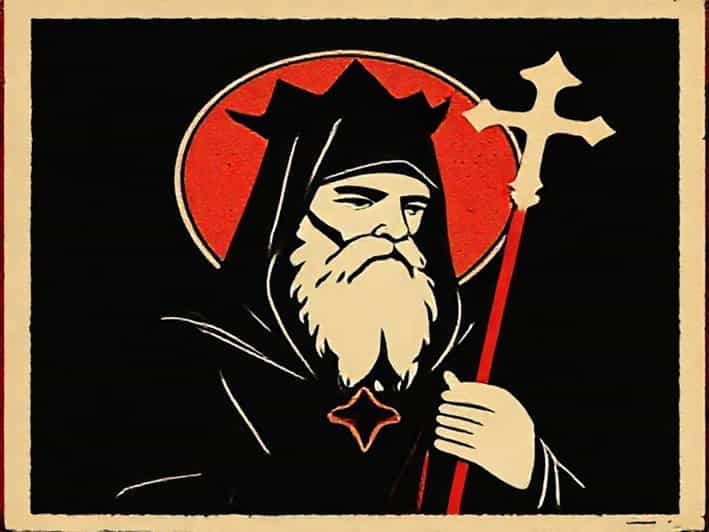
Grigori Rasputin, often remembered as a mystic and advisor to the last Russian royal family, remains one of the most controversial figures in Russian history. Known as the Saint Who Sinned, Rasputin’s life was a complex mix of spiritual influence, scandalous behavior, and political involvement. Born in 1869 in a small Siberian village, he rose from humble beginnings to become a powerful presence in the Russian court, wielding influence over Tsar Nicholas II and his family. While many admired his alleged healing abilities and spiritual insight, others criticized his indulgent lifestyle and moral ambiguities, leading to a legacy that continues to fascinate historians and the public alike.
Early Life and Spiritual Awakening
Rasputin’s early life was marked by poverty and religious curiosity. Growing up in the Siberian countryside, he was exposed to local Orthodox traditions and folklore, which shaped his spiritual beliefs. In his youth, he experienced what he described as a profound religious awakening, prompting him to leave his village and begin a pilgrimage across Russia. This period of wandering allowed him to meet various religious leaders, healers, and mystics, further deepening his understanding of spirituality and gaining a reputation as a man with extraordinary insight.
Path to Influence in the Russian Court
Rasputin’s journey eventually brought him to St. Petersburg, where his reputation as a healer and mystic caught the attention of the Russian royal family. Tsarina Alexandra, in particular, believed that Rasputin could heal her son, Alexei, who suffered from hemophilia. Rasputin’s apparent success in alleviating Alexei’s symptoms solidified his influence at court. Over time, his guidance extended beyond spiritual matters, as he became involved in political decisions and gained a level of power that alarmed many nobles and government officials.
The Duality of a Saint and a Sinner
The phrase the Saint Who Sinned encapsulates the duality of Rasputin’s life. On one hand, he was seen as a holy man capable of miraculous healing and spiritual counsel. On the other, he engaged in behaviors that scandalized the aristocracy, including heavy drinking, sexual promiscuity, and rumored manipulations of the royal family. This tension between perceived sanctity and immoral conduct contributed to both his mystique and his notoriety. Many contemporaries struggled to reconcile his spiritual influence with his controversial personal life.
Controversial Behavior and Public Perception
Rasputin’s behavior fueled rumors and controversy throughout his life. Members of the Russian elite accused him of exploiting his position for personal gain, while newspapers and public opinion sensationalized his actions. Despite his flaws, many of his followers remained devoted, believing that his sins were a form of holy eccentricity or a test of faith. This complex image of Rasputin as both a saint and a sinner made him a symbol of the contradictions and instability within the final years of the Russian Empire.
Political Influence and Historical Impact
Rasputin’s influence extended beyond the personal lives of the royal family into the political sphere. His advice and presence at court affected decisions regarding appointments, policy, and diplomacy. Critics argued that his influence weakened the monarchy and contributed to public distrust of Tsar Nicholas II’s leadership. While it is debated how much direct impact Rasputin had on political events, his association with corruption and scandal added to the perception that the Russian Empire was in decline, ultimately playing a part in the revolutionary movements that followed.
Assassination and Legacy
Rasputin’s life ended violently in 1916, when a group of nobles conspired to assassinate him. They believed that his death was necessary to save the monarchy and restore stability to Russia. Accounts of his murder highlight the dramatic and almost mythical aspects of his life, with stories of poison, multiple gunshots, and eventual drowning. Following his death, Rasputin became a legend, with tales of his influence and survival circulating widely. His legacy remains a blend of historical fact, rumor, and myth, reflecting the enduring fascination with his life as the Saint Who Sinned.
Rasputin in Popular Culture
Rasputin’s life has inspired countless books, films, and songs, solidifying his place in popular culture. His story captures the imagination because it combines elements of mysticism, scandal, and political intrigue. Movies and novels often portray him as a manipulative yet charismatic figure, emphasizing both his spiritual authority and his moral contradictions. The fascination with Rasputin reflects a broader human interest in complex figures who defy simple categorization, embodying both virtues and vices.
Lessons from Rasputin’s Life
Rasputin’s life offers lessons about power, influence, and the complexities of human nature. It demonstrates how charisma and perceived spiritual authority can grant significant social and political power, even to someone from humble beginnings. At the same time, his story highlights the risks of moral ambiguity and the consequences of public scrutiny. Rasputin’s life encourages reflection on the tension between human flaws and exceptional abilities, reminding us that historical figures are often multidimensional, resisting easy labels as entirely virtuous or entirely corrupt.
Grigori Rasputin remains one of history’s most enigmatic figures, a man whose life defied easy categorization. As the Saint Who Sinned, he embodies the paradox of a person capable of spiritual insight and healing, yet also prone to moral transgressions and scandalous behavior. His influence on the Russian royal family, his controversial public image, and his dramatic death have cemented his place in history as a symbol of both power and peril. Rasputin’s story continues to captivate historians, writers, and the general public, offering insight into the complex interplay of faith, influence, and human imperfection that defined his extraordinary life.