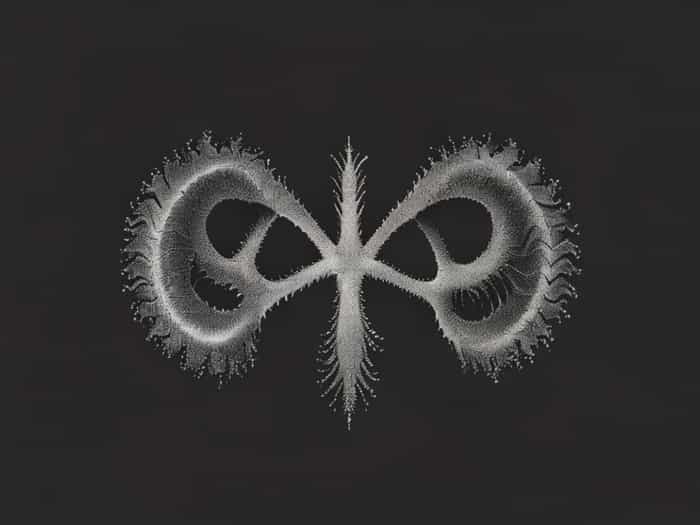
The Mandelbrot set is one of the most fascinating discoveries in mathematics, revealing intricate and infinitely complex patterns that have captured the imagination of mathematicians, scientists, and artists alike. At first glance, the Mandelbrot set appears as a simple black shape surrounded by a colorful array of patterns, but closer inspection reveals a world of endless complexity and self-similarity. Unveiling the Mandelbrot set allows us to explore the beauty of mathematics, the concept of fractals, and the surprising connections between simple equations and the infinite complexity found in nature.
Understanding the Mandelbrot Set
The Mandelbrot set is a collection of complex numbers that do not diverge when iteratively applied to a specific mathematical formula z_{n+1} = z_n^2 + c, where z and c are complex numbers. If the sequence remains bounded, the number c is part of the Mandelbrot set. This definition might seem abstract, but it generates stunning visual representations that are both mathematically significant and aesthetically captivating. The boundary of the Mandelbrot set is infinitely intricate, and zooming into it reveals self-similar structures that never repeat exactly, demonstrating one of the most famous examples of fractals in mathematics.
Historical Context
The Mandelbrot set was named after Benoît B. Mandelbrot, a mathematician who pioneered the study of fractals in the 20th century. Mandelbrot’s work challenged traditional views of geometry, showing that many natural structures such as coastlines, clouds, and mountains exhibit fractal-like properties. The discovery of the Mandelbrot set in the late 1970s was facilitated by advances in computer technology, which allowed mathematicians to visualize the set in detail. This combination of theoretical insight and computational power enabled a new way of exploring mathematics visually and conceptually.
Mathematical Properties
The Mandelbrot set exhibits several unique mathematical properties that make it a central object of study in complex dynamics and fractal geometry. It is connected, meaning it forms a single unbroken shape, yet its boundary is infinitely complex. Zooming into the boundary reveals miniaturized copies of the original set, a property known as self-similarity. Despite the apparent complexity, the rules generating the Mandelbrot set are remarkably simple, highlighting the profound idea that simple formulas can lead to infinitely intricate outcomes.
Key Features
- Infinite complexity along the boundary
- Self-similarity and repeating patterns at various scales
- Simple mathematical formula generating complex structures
- Fractal dimension greater than its topological dimension
- Connections to chaos theory and dynamical systems
Visualization and Color Mapping
Visualizing the Mandelbrot set has been a significant factor in its popularity beyond mathematics. Computers assign colors to points based on how quickly sequences diverge. Points that remain bounded are typically colored black, while points that escape to infinity are assigned colors according to the speed of divergence. This method creates strikingly detailed images, often with swirling, spiraling, and repetitive patterns that invite viewers to explore deeper. Visualization not only makes the Mandelbrot set accessible but also demonstrates the intersection of mathematics, art, and technology.
Techniques for Visualization
- Iteration counting to determine divergence rates
- Color gradients to emphasize detail and depth
- Zooming into boundary regions to reveal self-similar structures
- Use of high-resolution rendering to capture intricate details
- Application in digital art and computer graphics
Applications in Science and Art
The Mandelbrot set extends beyond pure mathematics into diverse fields. In science, it helps model natural phenomena such as turbulence, population dynamics, and fluid patterns. Fractals derived from the Mandelbrot set also inform algorithms in computer graphics, allowing realistic rendering of landscapes, clouds, and textures. Artists are drawn to the set for its visual beauty, using its patterns to create mesmerizing digital artwork. This crossover between mathematics, science, and art highlights the universal appeal and applicability of fractals.
Scientific and Artistic Uses
- Modeling natural fractal phenomena
- Simulating complex systems in physics and biology
- Generating realistic textures and landscapes in computer graphics
- Creating abstract and digital art inspired by fractals
- Exploring chaos theory and dynamical systems in research
Exploring the Infinite
One of the most intriguing aspects of the Mandelbrot set is its infinite detail. Zooming into its boundary reveals endlessly complex structures that continue without repetition. This characteristic captures the imagination, as it allows both mathematicians and enthusiasts to explore infinite detail in a finite visual space. The concept of infinite complexity arising from simple rules resonates with broader philosophical and scientific questions about order, chaos, and the nature of the universe.
Concepts Illustrated by the Mandelbrot Set
- Infinite complexity from simple mathematical rules
- Fractals and self-similarity in nature and mathematics
- Connections between order and chaos
- Visualization of abstract mathematical ideas
- Inspiration for further exploration in mathematical research
Learning and Research Opportunities
The Mandelbrot set serves as an excellent entry point for students and researchers interested in complex dynamics, fractals, and computational mathematics. By studying the set, learners gain insight into iterative processes, convergence, divergence, and the properties of complex numbers. Advanced research often involves exploring the connections between the Mandelbrot set and Julia sets, another family of fractals, as well as applications in physics, biology, and computer science. Engaging with the Mandelbrot set can inspire curiosity, enhance problem-solving skills, and foster appreciation for the elegance of mathematics.
Educational Insights
- Understanding complex numbers and iterative functions
- Introduction to fractal geometry and its properties
- Exploration of dynamical systems and chaos theory
- Computational techniques for visualization and analysis
- Interdisciplinary connections to science, art, and technology
Unveiling the Mandelbrot set reveals a world where simplicity gives rise to infinite complexity, blending mathematics, art, and science in a single framework. Its discovery and visualization have transformed how we perceive patterns, chaos, and order, offering a striking example of the beauty inherent in mathematical structures. The set’s endless detail, self-similarity, and aesthetic appeal make it a source of fascination for mathematicians, scientists, artists, and curious minds worldwide.
The Mandelbrot set stands as a symbol of the profound connections between abstract mathematics and tangible beauty. Its patterns encourage exploration, inspire creativity, and offer insights into natural and theoretical phenomena. Whether approached from a mathematical perspective, an artistic lens, or simply as an object of wonder, the Mandelbrot set continues to captivate audiences, proving that the unveiling of its secrets is both a scientific endeavor and a celebration of infinite complexity and creativity.