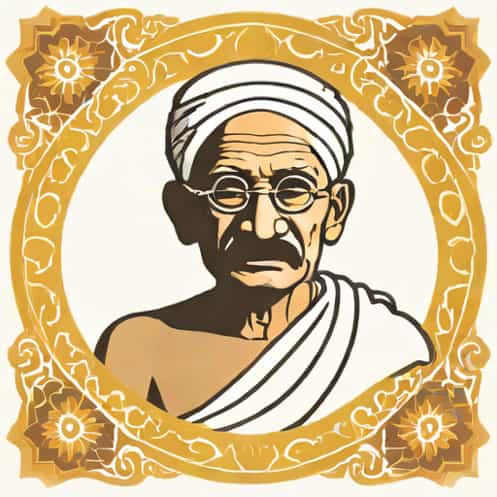
Mahatma Gandhi stands as one of the most influential figures in modern history, particularly for his role in leading India’s nationalist movement against British colonial rule. His philosophy of nonviolence, or ahimsa, and his commitment to civil disobedience transformed political activism and inspired millions. Gandhi’s leadership was not merely about opposing foreign rule; it was a broader vision for social justice, self-reliance, and moral integrity that resonated deeply with people from diverse backgrounds. Understanding Gandhi’s contribution to the nationalist movement requires examining his strategies, philosophies, and the historical context in which he operated, as well as the enduring impact on Indian society and global movements for freedom.
Early Life and Influences
Born in 1869 in Porbandar, India, Mohandas Karamchand Gandhi’s early experiences shaped his commitment to justice and nonviolence. Educated in law in London, Gandhi’s exposure to Western political ideas merged with his deep-rooted spiritual and cultural values. His formative years in South Africa, where he faced racial discrimination, played a critical role in shaping his approach to activism. It was in South Africa that Gandhi developed Satyagraha, a method of nonviolent resistance designed to challenge injustice through moral persuasion rather than physical confrontation. This philosophy later became central to India’s struggle for independence.
Key Influences
- Religious and cultural upbringing in Hinduism and Jainism
- Exposure to Western legal education and ethics
- Experience of racial discrimination in South Africa
- Philosophy of nonviolence and civil resistance
The Nationalist Movement in India
The Indian nationalist movement sought to end British colonial rule and secure self-governance. Gandhi emerged as a central leader during a period of growing political consciousness among Indians, who were frustrated by oppressive laws, economic exploitation, and social inequalities. The movement was characterized by mass mobilization, political campaigns, and public demonstrations, and Gandhi’s strategies emphasized nonviolent protest, moral discipline, and mass participation. Unlike previous approaches that relied heavily on elite negotiations, Gandhi empowered ordinary citizens to take an active role in shaping their political destiny.
Major Campaigns Led by Gandhi
- Non-Cooperation Movement (1920-1922)Encouraged Indians to boycott British institutions, schools, and goods to weaken colonial authority.
- Salt March (1930)A 240-mile march to produce salt in defiance of British laws, symbolizing mass civil disobedience and inspiring international attention.
- Quit India Movement (1942)Called for immediate British withdrawal, mobilizing millions in widespread protests despite repression.
- Promotion of Khadi and SwadeshiEncouraged self-reliance through local goods, challenging the economic dominance of British imports.
Philosophy and Methods
Gandhi’s approach combined ethical principles with practical political strategies. His philosophy of Satyagraha was rooted in the belief that nonviolence is not passive but a powerful tool for confronting oppression. Civil disobedience, boycotts, and peaceful protests were methods designed to awaken moral conscience, both among the oppressors and the oppressed. Gandhi also emphasized truth (satya) and self-discipline as essential components of effective resistance. This moral framework distinguished his leadership from purely political or military approaches, giving the nationalist movement a unique ethical dimension.
Principles of Gandhi’s Philosophy
- AhimsaNonviolence in thought, word, and action
- SatyagrahaInsistence on truth and moral persuasion
- Self-relianceEconomic independence through local production and Swadeshi
- Mass participationMobilizing ordinary citizens for social and political change
Challenges and Opposition
Gandhi’s leadership was not without challenges. Within India, some political groups disagreed with his nonviolent methods, arguing for more militant action. The British government responded to his campaigns with arrests, repression, and censorship. Additionally, social issues such as caste discrimination and communal tensions required Gandhi to navigate complex social landscapes. Despite these obstacles, Gandhi maintained his principles, believing that ethical leadership could achieve lasting change more effectively than force or coercion. His ability to unify diverse groups under a common vision was instrumental in sustaining the nationalist movement.
Overcoming Challenges
- Negotiating between various political factions and communities
- Maintaining commitment to nonviolence despite repression
- Addressing social issues alongside political goals
- Using moral authority to gain national and international support
Legacy of Gandhi and the Nationalist Movement
The nationalist movement, under Gandhi’s leadership, ultimately contributed to India gaining independence in 1947. Beyond political freedom, Gandhi’s methods and philosophy influenced global movements for civil rights, social justice, and decolonization. Leaders like Martin Luther King Jr. and Nelson Mandela drew inspiration from Gandhi’s principles of nonviolent resistance. In India, Gandhi’s vision continues to shape social and political discourse, emphasizing ethical governance, community participation, and moral integrity. His legacy illustrates how a principled approach to activism can achieve profound and lasting change.
Enduring Impact
- Inspiration for civil rights movements worldwide
- Promotion of nonviolence as a political strategy
- Encouragement of self-reliance and community empowerment
- Ongoing relevance in ethical and social leadership
Mahatma Gandhi’s role in the nationalist movement exemplifies the power of ethical leadership, strategic nonviolence, and mass mobilization. His vision extended beyond political independence, emphasizing moral integrity, social justice, and the empowerment of ordinary citizens. Gandhi’s strategies transformed the Indian nationalist movement into a mass movement with enduring influence, not only in India but across the world. By understanding Gandhi’s contributions, we recognize the intersection of moral philosophy and political action, illustrating how principled leadership can bring about lasting social and political transformation.