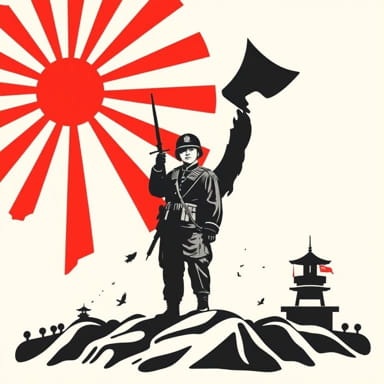
In the early 20th century, Japan underwent a profound transformation that led to the aggressive expansion of its military influence both domestically and abroad. The rise of militarism in Japan did not happen overnight; it was the result of a combination of socio-political, economic, and cultural factors. The militarist ideology came to dominate Japanese politics and foreign policy, fueling imperialist ambitions across Asia. This shift fundamentally altered Japan’s role in international affairs and led the country into conflicts that would shape global history, including World War II.
Historical Background of Japanese Militarism
The Meiji Restoration and Modernization
To understand the rise of militarism in Japan, one must begin with the Meiji Restoration of 1868. This period marked the end of the Tokugawa shogunate and the return of political power to the emperor. The new Meiji leaders recognized the importance of modernizing Japan to compete with Western powers. This modernization included the development of a strong centralized government, a modern industrial economy, and a powerful, Western-style military.
Under the Meiji regime, Japan rapidly industrialized, built railways, and expanded its armed forces. The new Imperial Japanese Army and Navy were modeled after European militaries, particularly those of Germany and Britain. Military service became a point of national pride, and soldiers were celebrated as symbols of the new Japanese identity.
Early Victories and Growing Ambition
Japan’s military success in the First Sino-Japanese War (1894-1895) and the Russo-Japanese War (1904-1905) bolstered national confidence. These victories were not just military triumphs they also secured Japan’s position as a major power in East Asia. The wars allowed Japan to gain control over territories like Taiwan, Korea, and parts of Manchuria, which became key resources for industrial growth.
As Japan acquired new colonies, a militaristic culture started to take root. The belief that military strength equaled national strength grew more popular among the elite and the general population. The education system promoted loyalty to the emperor and the idea that dying for one’s country was the highest honor.
Political Instability and Rise of the Military
Weak Civilian Government
Throughout the 1920s and 1930s, Japan experienced a series of political crises. The parliamentary system was weak and fragmented, with frequent changes in leadership. Civilian leaders struggled to address domestic problems such as economic depression, social unrest, and labor strikes. As a result, the public lost faith in political parties and democratic institutions.
This vacuum allowed military leaders to gain greater influence over national policy. The army and navy began to act independently of the civilian government, often engaging in unauthorized military actions in foreign territories. The public and the media largely supported these moves, as they were seen as efforts to restore Japan’s prestige and economic strength.
The Manchurian Incident
One of the most significant turning points came in 1931 with the Manchurian Incident. A group of Japanese officers staged a railway explosion in Manchuria and used it as a pretext to invade the region. Despite orders from Tokyo to withdraw, the army continued its campaign, eventually establishing the puppet state of Manchukuo.
The government’s failure to punish those responsible demonstrated the military’s autonomy and undermined civilian control. The League of Nations condemned Japan’s actions, but Japan simply withdrew from the organization, signaling a break from international norms and a pivot toward aggressive nationalism.
Ideological Foundations of Japanese Militarism
Emperor Worship and Bushido
Militarism in Japan was supported by a unique set of cultural and ideological beliefs. Central to this was the notion of emperor worship. The emperor was regarded as a divine figure, the direct descendant of the sun goddess Amaterasu. Serving the emperor became synonymous with serving the nation.
Another key element was the revival of Bushido, the traditional samurai code of honor. This code emphasized loyalty, discipline, and sacrifice. It was repurposed to promote the idea that soldiers must be ready to die for their country. These values were heavily promoted in schools and the media, shaping the mindset of an entire generation.
Ultranationalism and Xenophobia
Alongside emperor worship and Bushido, a dangerous strain of ultranationalism took hold. The Japanese were taught that their race and culture were superior to others, especially those of neighboring Asian countries. Foreigners were often depicted as threats to Japanese purity and sovereignty.
This ideology justified expansion into other parts of Asia, under the guise of the ‘Greater East Asia Co-Prosperity Sphere’ a concept that claimed Japan was liberating Asia from Western imperialism. In reality, it led to brutal occupation and exploitation of conquered regions.
Economic Factors and Expansionist Policy
Impact of the Great Depression
The global economic downturn of the 1930s hit Japan hard. Exports plummeted, unemployment rose, and poverty spread throughout the country. The government’s inability to manage the crisis further discredited civilian leadership and gave the military an opportunity to step in with solutions.
Militarists argued that Japan needed new territories to secure resources like oil, coal, and rubber. They claimed that economic independence could only be achieved through territorial expansion. These arguments resonated with the public and gave the military justification for further aggression.
Invasion of China
By 1937, Japan launched a full-scale invasion of China, beginning with the Marco Polo Bridge Incident. The Second Sino-Japanese War would become one of the bloodiest conflicts in Asia. Japanese troops committed atrocities such as the Nanjing Massacre, shocking the world and further isolating Japan diplomatically.
Despite international condemnation, militarism continued to dominate Japanese policy. Political parties were dissolved, dissent was suppressed, and Japan became a one-party state under military rule. The country moved inexorably toward conflict with the Western powers, particularly the United States.
Consequences of Japanese Militarism
Path to World War II
The rise of militarism set Japan on a collision course with other world powers. The attack on Pearl Harbor in 1941 was the culmination of decades of military buildup and expansionist policy. Japan believed that war with the West was inevitable and chose to strike first in hopes of gaining a strategic advantage.
However, the decision proved disastrous. Japan was drawn into a prolonged and devastating war that eventually led to its defeat and occupation by Allied forces. The legacy of militarism left deep scars, both domestically and across Asia.
Post-War Reforms
After World War II, Japan underwent significant changes. The Allied occupation led by the United States dismantled the military government, rewrote the constitution, and imposed strict limits on Japan’s ability to wage war. topic 9 of the Japanese Constitution explicitly renounces war as a sovereign right.
In the post-war era, Japan reinvented itself as a peaceful, democratic nation. While its Self-Defense Forces remain among the most advanced in the world, Japan has largely avoided direct military conflict and has become a global symbol of pacifism and economic resilience.
The rise of militarism in Japan was a complex process fueled by nationalism, economic hardship, and ideological zeal. While it brought temporary gains in territory and prestige, it ultimately led to tragedy and destruction. Understanding this history is essential to recognizing the dangers of unchecked military power and the importance of maintaining democratic institutions and international cooperation.