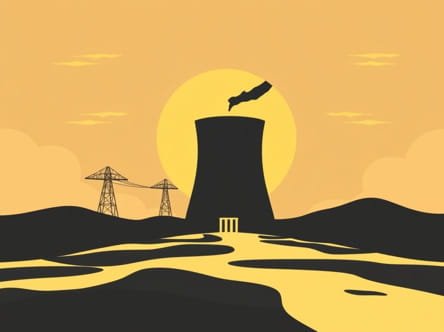
In the mid-20th century, a remarkable transformation unfolded in both military and civilian sectors, as nuclear energy moved from theoretical science to practical application. At the center of this dramatic shift was Admiral Hyman G. Rickover, a determined and visionary engineer in the United States Navy. Known as the ‘Father of the Nuclear Navy,’ Rickover played a decisive role in developing nuclear-powered submarines and also influenced the emergence of civilian nuclear power in the United States. His efforts not only revolutionized naval operations but also gave birth to a new era of energy innovation that continues to shape the modern world.
Early Life and Engineering Background
Hyman George Rickover was born in 1900 in Poland and immigrated to the United States with his family as a child. He graduated from the U.S. Naval Academy in 1922 and soon pursued engineering studies, eventually earning a Master’s degree in electrical engineering from Columbia University. Rickover’s technical training and keen attention to detail would later become central to his work in naval innovation.
His early career in the Navy included assignments on various surface ships, but his growing interest in advanced propulsion systems steered him toward the Bureau of Ships. It was there that he began to explore the possibilities of atomic energy for naval propulsion a field that was still in its infancy but held immense promise.
The Vision for Nuclear Submarines
After World War II, scientific discoveries about nuclear fission opened new possibilities for energy use. Rickover became convinced that nuclear power could provide submarines with virtually unlimited underwater endurance. At that time, submarines were primarily diesel-electric, which meant they needed to surface frequently to recharge batteries, making them vulnerable to detection and attack.
Rickover envisioned a radical departure from this vulnerability. A nuclear-powered submarine would be capable of staying submerged for weeks or even months at a time, transforming naval warfare and defense strategy. He relentlessly pursued this idea, advocating within the Navy and to Congress for funding and authority to pursue nuclear propulsion.
The Launch of USS Nautilus
Thanks to Rickover’s persistence and technical expertise, the first nuclear-powered submarine, USSNautilus(SSN-571), was launched in 1954. It was a historic achievement and a testament to what engineering vision and disciplined management could accomplish.
TheNautilusdemonstrated the immense advantages of nuclear propulsion: greater range, higher speeds, and unmatched endurance underwater. It could travel under the polar ice cap, navigate thousands of miles without surfacing, and remain operational for extended periods. Rickover’s dream had become a reality, and the U.S. Navy entered a new era of power and capability.
Rickover’s Influence on Nuclear Safety and Standards
One of Rickover’s most lasting contributions was his insistence on the highest standards of safety, training, and engineering discipline. He demanded rigorous testing and accountability at every level. His leadership style was intense, and he maintained a hands-on approach, personally interviewing candidates for nuclear command and scrutinizing every component of reactor design.
His philosophy was clear: nuclear energy was too powerful and too dangerous to tolerate mediocrity or carelessness. The result of his exacting standards was an extraordinary safety record in the U.S. nuclear submarine fleet, with no reactor-related accidents in over six decades of operation.
Extending Nuclear Power to Civilian Energy
Rickover did not limit his ambitions to the military domain. Recognizing the broader potential of nuclear energy, he actively supported the development of civilian nuclear reactors. In 1957, under his guidance, the first full-scale commercial nuclear power plant in the United States, the Shippingport Atomic Power Station in Pennsylvania, became operational.
This plant was a prototype for future civilian reactors and marked the beginning of the nuclear energy industry in the United States. Rickover saw nuclear power not only as a tool of national defense but also as a way to reduce dependence on fossil fuels and meet growing energy demands.
Leadership, Legacy, and Criticism
Rickover served in the U.S. Navy for over 60 years, the longest-serving military officer in American history at the time of his retirement in 1982. Throughout his career, he received numerous accolades, including two Congressional Gold Medals and the Presidential Medal of Freedom.
Despite his achievements, Rickover was not without critics. His management style was described by some as abrasive and authoritarian. He insisted on absolute control over nuclear programs, which occasionally put him at odds with superiors and colleagues. Yet even his critics often admitted that his rigid standards ensured excellence and avoided disaster.
The Global Impact of Rickover’s Work
The global influence of Rickover’s work can hardly be overstated. Many nations followed the U.S. lead in developing nuclear-powered submarines, and civilian nuclear energy expanded across the globe. Rickover’s success demonstrated that with strong leadership, rigorous oversight, and a clear vision, even the most complex technologies could be harnessed for both security and progress.
Today, nuclear power remains a vital part of the energy mix in many countries, offering low-carbon electricity and high reliability. The technologies developed under Rickover’s watch continue to inform modern reactor designs and safety protocols.
Enduring Principles and Modern Relevance
Rickover believed that integrity, education, and responsibility were essential to the use of advanced technology. His emphasis on engineering discipline and his deep mistrust of shortcuts are lessons that remain relevant in modern technological fields, from artificial intelligence to space exploration.
As energy demands rise and climate concerns grow, Rickover’s early promotion of nuclear power as a stable, non-polluting energy source gains renewed attention. While debates around nuclear waste and costs persist, many experts today advocate for expanding nuclear energy an idea that Rickover promoted more than half a century ago.
Admiral Hyman G. Rickover was more than a military innovator; he was a transformative figure whose work helped redefine the boundaries of science, engineering, and national policy. Through his leadership, the world saw the birth of nuclear power, not just as a concept, but as a reality that could drive submarines, light cities, and inspire new generations of engineers.
The legacy of Rickover and the nuclear power movement he championed continues to shape the 21st century, reminding us that the future often depends on the vision, discipline, and courage of individuals who dare to think beyond the status quo.