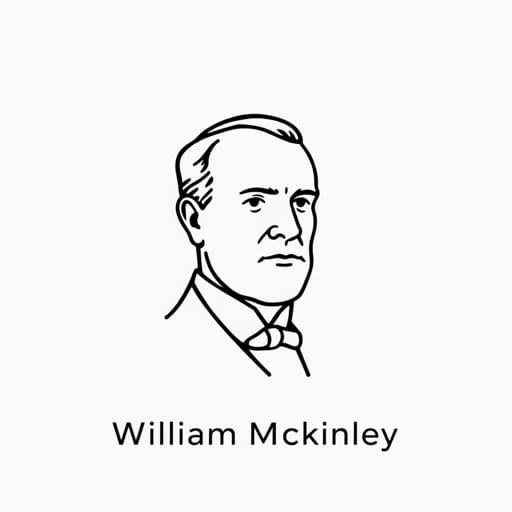
William McKinley was the 25th president of the United States, serving from 1897 until his assassination in 1901. His presidency marked a turning point in American history, as the nation transitioned into the 20th century with a growing sense of industrial power and global influence. Known for his calm demeanor, strong leadership during the Spanish-American War, and his support for protective tariffs, McKinley was a key figure in the Republican Party and a symbol of American economic expansion. Understanding how William McKinley governed, what he stood for, and how he was remembered provides valuable insights into a critical era in American political development.
Early Life and Political Rise
William McKinley was born in Niles, Ohio, in 1843. Coming from modest beginnings, he studied at Allegheny College and later served in the Union Army during the Civil War. His military service shaped his patriotic worldview and built the foundation for his future political career.
After the war, McKinley became a lawyer and entered politics as a member of the Republican Party. He served in the U.S. House of Representatives for several terms, where he became well-known for his advocacy of high tariffs to protect American industries. The McKinley Tariff of 1890, though controversial, made his name nationally recognized and reflected his deep commitment to American manufacturing.
Governor of Ohio
Before becoming president, McKinley served two terms as governor of Ohio. His administration focused on fiscal responsibility, labor rights, and business development. As governor, he earned a reputation for fairness, balancing the needs of both industrialists and workers. His popularity in Ohio helped pave the way for his presidential nomination in 1896.
The Election of 1896
McKinley’s presidential campaign in 1896 was one of the most significant in American history. Running against Democrat William Jennings Bryan, McKinley represented the pro-business, gold-standard wing of the Republican Party. Bryan, on the other hand, championed free silver and agrarian populism.
With the support of political strategist Mark Hanna, McKinley conducted a ‘front porch campaign’ from his home in Canton, Ohio. Rather than traveling the country, he welcomed delegations and gave speeches to the press and visitors. His strategy portrayed him as stable, presidential, and trustworthy during a time of economic uncertainty.
- Advocated for the gold standard over free silver
- Supported high tariffs to protect American labor and industry
- Promoted economic stability and business growth
McKinley won the election with a clear majority, signaling a shift in American politics toward urban, industrial interests and away from rural populism.
Presidency and Major Achievements
Economic Recovery
When McKinley took office, the country was recovering from the Panic of 1893, a severe economic depression. His administration focused on restoring confidence through sound monetary policy and business-friendly legislation. The Dingley Tariff Act of 1897 raised import duties and reinforced his belief in protecting American industries.
Spanish-American War
One of the defining events of McKinley’s presidency was the Spanish-American War in 1898. Although McKinley initially resisted calls for intervention in Cuba’s independence struggle, public pressure grew after the explosion of the USS Maine in Havana Harbor.
McKinley eventually asked Congress for the authority to intervene. The war was brief but transformative. The United States defeated Spain and gained control over former Spanish territories, including the Philippines, Guam, and Puerto Rico. This marked the beginning of America’s emergence as a global power.
Annexation of Hawaii and Expansion
During McKinley’s term, Hawaii was annexed in 1898, further extending American influence in the Pacific. His administration’s expansionist policies were often justified by a belief in American exceptionalism and the duty to ‘civilize’ other nations a reflection of the imperial mindset of the era.
Second Term and the Gold Standard Act
McKinley was reelected in 1900, once again defeating William Jennings Bryan. His second term continued his economic focus, culminating in the Gold Standard Act of 1900, which formally committed the U.S. to gold-backed currency, ending years of debate over bimetallism.
Personal Character and Leadership Style
William McKinley was known for his courteous manner and calm disposition. He avoided conflict when possible and preferred to build consensus rather than impose his will. Despite his gentle personality, he was a decisive leader, especially when it came to matters of national interest.
He had a close relationship with his wife, Ida, who suffered from health issues. McKinley was deeply devoted to her and often adjusted his schedule to care for her. This humanized him in the eyes of the public and added to his personal appeal.
Assassination and Legacy
Tragically, McKinley’s life and presidency were cut short when he was assassinated in September 1901 by anarchist Leon Czolgosz during a public reception in Buffalo, New York. He died eight days later from gangrene caused by his wounds. His vice president, Theodore Roosevelt, succeeded him.
McKinley’s death shocked the nation and led to a national period of mourning. He was remembered as a steady and honorable leader who guided the United States into a new century with dignity and strength. Though overshadowed by Roosevelt’s dynamic legacy, McKinley laid the groundwork for America’s global role and economic expansion.
How Was William McKinley Viewed Historically?
Historians have often debated McKinley’s significance. Some criticized his conservative approach and saw him as a president dominated by party leaders like Mark Hanna. Others have re-evaluated his presidency, recognizing his importance in transitioning the U.S. from a post-Civil War society into an industrial and imperial power.
Recent scholarship emphasizes McKinley’s strategic thinking, especially his careful entry into the Spanish-American War and his emphasis on economic stability. His vision for a strong, prosperous America shaped the policies of future presidents.
Notable Aspects of McKinley’s Presidency
- Strengthened America’s industrial economy
- Oversaw significant territorial expansion
- Demonstrated calm leadership during wartime
- Committed to stability and conservative economic principles
William McKinley was a pivotal figure at a transformative moment in American history. His presidency helped usher in a new era of economic strength and global influence. Through his leadership in war, support for industry, and measured approach to governance, McKinley left a lasting mark on the nation. Though not always remembered as boldly as some of his successors, his role in shaping modern America remains undeniable. In exploring how William McKinley led, governed, and impacted the world, we gain a fuller picture of a man whose legacy deserves renewed attention.