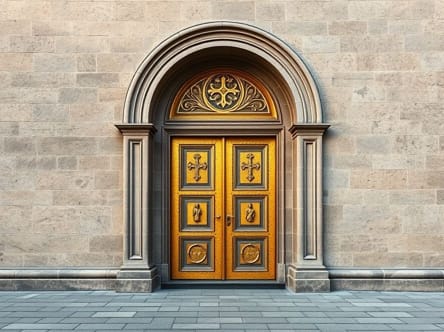
The North Doors of the Florence Baptistery, created by Lorenzo Ghiberti, stand as one of the most celebrated masterpieces of the Italian Renaissance. Located opposite the Florence Cathedral in Piazza del Duomo, the doors are a prime example of artistic innovation, technical mastery, and religious devotion. Commissioned in the early 15th century, these bronze doors mark a transition in art history, blending Gothic tradition with emerging Renaissance ideals. Ghiberti’s work on the North Doors captivated viewers not only for its detailed biblical narratives but also for its pioneering use of perspective, realistic figures, and decorative beauty that influenced generations of artists.
Historical Context of the North Doors
The Florence Baptistery, dedicated to St. John the Baptist, is one of the city’s oldest and most revered religious structures. By the 15th century, its doors had become a symbolic focal point. Following the success of the earlier South Doors by Andrea Pisano, the Arte di Calimala (the cloth merchants’ guild) commissioned new doors for the north side in 1401. This competition attracted many prominent artists of the time and is often considered the beginning of Renaissance art in Florence.
Ghiberti Wins the Competition
The competition required artists to submit a bronze panel depicting the Sacrifice of Isaac. Ghiberti’s submission stood out for its grace, clarity, and technical excellence. He won the commission, defeating competitors like Filippo Brunelleschi, and began working on the North Doors in 1403. The project would occupy him for over 20 years, concluding in 1424.
Design and Structure of the North Doors
The North Doors consist of 28 rectangular panels arranged in seven rows of four. Each panel measures approximately 50 centimeters across and is framed by intricate decorative borders.
Thematic Organization
- Top 20 panels: Scenes from the life of Christ, including the Nativity, Baptism, Crucifixion, and Resurrection.
- Bottom 8 panels: Represent the four Evangelists and four early Church Fathers (Ambrose, Jerome, Augustine, and Gregory).
Ghiberti chose a chronological narrative style that progresses from top to bottom, guiding viewers through the story of salvation. Each panel captures a pivotal biblical moment with remarkable detail and emotion.
Frame and Decoration
The door frames are equally significant. Ghiberti designed elegant borders featuring foliage, small busts, and decorative motifs that enhance the visual harmony of the whole work. The use of gold gilding on the bronze gives the doors a luminous quality that reflects light beautifully, drawing attention even from a distance.
Innovative Artistic Techniques
Ghiberti’s North Doors are a milestone in the development of Renaissance art due to the techniques he pioneered. His panels reflect a deep understanding of human anatomy, spatial composition, and emotional expression.
Use of Perspective
Though linear perspective was still developing, Ghiberti experimented with depth and spatial illusion by overlapping figures and creating architectural backgrounds. This technique allowed scenes to appear more lifelike and dynamic.
Naturalism and Human Emotion
Unlike earlier Gothic works that often appeared static and rigid, Ghiberti’s figures display movement, grace, and emotional nuance. Characters interact with one another in believable ways, drawing viewers into the story.
Bronze Casting and Detailing
Creating the North Doors required sophisticated bronze casting techniques. Ghiberti used the lost-wax method to create highly detailed reliefs. His ability to render fine details, such as facial expressions, drapery folds, and textures, was unmatched at the time.
Symbolism and Religious Meaning
The doors serve not only as art but also as a theological statement. Each panel is carefully crafted to reflect Christian themes of faith, redemption, and divine intervention. The Evangelists and Church Fathers at the bottom signify the foundation of Christian doctrine, while the scenes above them illustrate Christ’s life and mission.
A Public Statement of Faith
Positioned at the entrance to the baptistery, the doors symbolically welcome believers into the Christian community. The choice of scenes emphasizes key events in the life of Christ, reinforcing the importance of baptism and spiritual renewal.
Ghiberti’s Influence on the Renaissance
Ghiberti’s North Doors played a crucial role in shaping the direction of Renaissance art. His work demonstrated how classical principles could be adapted to Christian themes. Young artists like Donatello and Michelangelo studied his techniques and incorporated them into their own masterpieces.
Apprenticeship and Legacy
Ghiberti operated a large workshop where many future Renaissance masters trained. His emphasis on drawing from life, studying classical sculpture, and mastering technical craft helped define the Florentine school of art.
The Doors as a Model
Many later works in sculpture and relief art owe a debt to Ghiberti’s North Doors. Their clarity of narrative, balanced composition, and expressive detail set new standards for public and religious art in Europe.
Preservation and Current Location
To preserve the North Doors, the original panels were removed in the 20th century and placed in the Museo dell’Opera del Duomo in Florence. The doors now displayed at the baptistery are exact replicas. This ensures the continued admiration of Ghiberti’s work while protecting the fragile originals from weather and pollution.
Restoration Efforts
Over the years, the doors have undergone careful cleaning and conservation. Specialists have worked to maintain the original gilding and repair areas damaged by corrosion or environmental factors. These efforts ensure that future generations can appreciate the craftsmanship and historical value of the North Doors.
Comparison with the Gates of Paradise
After completing the North Doors, Ghiberti was commissioned again to create another set of doors for the east side of the baptistery. These became known as the ‘Gates of Paradise,’ a name given by Michelangelo. While the Gates of Paradise reflect a more mature and classical style, the North Doors remain a significant turning point in Ghiberti’s career and in art history.
Evolution of Style
The North Doors show a transition from the Gothic to the Renaissance style, whereas the Gates of Paradise are fully grounded in Renaissance ideals. Both sets of doors, however, showcase Ghiberti’s unmatched talent in storytelling and technical execution.
The North Doors of the Florence Baptistery are far more than a functional entryway they are a profound artistic and spiritual achievement. Ghiberti’s mastery of bronze, his innovative use of perspective, and his commitment to narrative clarity made the doors a symbol of Renaissance progress. For centuries, they have inspired artists, historians, and visitors from around the world. As a testament to Florence’s artistic heritage and a reflection of one man’s vision and talent, Ghiberti’s North Doors remain a masterpiece that continues to resonate with beauty, meaning, and historical importance.