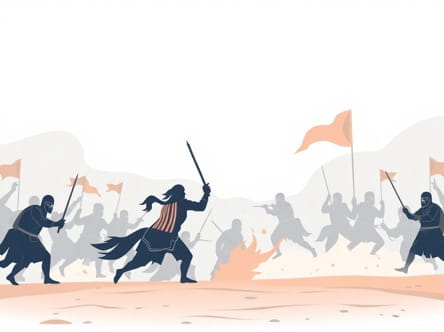
The Second Battle of Panipat stands as one of the most decisive confrontations in Indian history, dramatically altering the course of the subcontinent’s future. Taking place on November 5, 1556, this fierce clash was fought between the forces of the young Mughal Emperor Akbar and Hemu, the Hindu general and chief minister of the Afghan king Adil Shah Suri. The outcome of the battle not only restored Mughal control over northern India but also shaped the political dynamics of the region for centuries to come. This historic encounter holds a central place in the military and political narrative of the Indian subcontinent.
Background of the Battle
The Fall and Rise of the Mughals
Before the Second Battle of Panipat, the Mughal Empire had experienced significant instability. Babur, the founder of the empire, had secured a major victory at the First Battle of Panipat in 1526. However, his son Humayun failed to maintain control and was later exiled by Sher Shah Suri, the founder of the short-lived Suri dynasty. Sher Shah implemented many administrative reforms and ruled effectively until his death. His successors, however, lacked his leadership skills.
Meanwhile, Humayun, with the help of the Persian Empire, reclaimed parts of India and re-established the Mughal throne shortly before his death in 1556. His young son Akbar, only 13 years old at the time, was declared emperor under the regency of his trusted general, Bairam Khan.
The Rise of Hemu
Hemu, also known as Hem Chandra Vikramaditya, was a brilliant military commander and an able administrator. Under Adil Shah Suri, Hemu had won several battles and controlled vast regions of northern India, including Delhi and Agra. Sensing an opportunity after Humayun’s death, Hemu marched towards Delhi with the goal of crushing the Mughal forces and establishing Hindu rule in India.
Forces and Preparations
The Mughal Army
The Mughal forces were led nominally by Akbar but effectively commanded by Bairam Khan. Although outnumbered, the Mughals had superior strategy, discipline, and experience on their side. The army also had access to advanced artillery, a crucial advantage in early modern warfare.
Hemu’s Forces
Hemu’s army was significantly larger and well-equipped, with around 30,000 cavalry, 500 elephants, and a large infantry. He had already secured Delhi without much resistance and was emboldened by a string of earlier victories. Hemu led his troops personally, riding atop a war elephant named Hawai.
The Battle Begins
Location and Strategy
The battle took place near the historic town of Panipat, located in present-day Haryana. The choice of Panipat was strategic, as it served as a traditional battleground for control over the northern plains of India. The Mughal forces adopted a defensive stance, using their artillery and cavalry effectively. Hemu, on the other hand, launched a frontal assault with confidence due to his numerical superiority.
Turning Point in the Battle
Initially, Hemu’s army seemed to gain the upper hand. His war elephants caused considerable chaos among Mughal ranks. However, the tide of the battle shifted dramatically when Hemu was struck in the eye by an arrow and lost consciousness. This single event threw his army into confusion. With their leader incapacitated, Hemu’s troops lost morale and began to scatter.
Aftermath of the Battle
The Fate of Hemu
Hemu was captured alive and brought before Akbar. While Bairam Khan advocated for the emperor to carry out the execution as a symbol of victory, it is believed that Akbar hesitated. However, Hemu was eventually executed, marking a critical point in the Mughal assertion of power in India.
Consolidation of Mughal Rule
With this victory, the Mughal Empire regained control over Delhi and most of northern India. This win was not just a military success but also a psychological one, as it restored confidence in the young Akbar’s leadership. The empire would go on to expand and flourish under Akbar, who became one of the most celebrated rulers in Indian history.
Significance of the Battle
- Political Legacy: The battle ended Afghan dominance in northern India and paved the way for a centralized Mughal administration.
- Military Impact: The engagement highlighted the importance of leadership, artillery, and disciplined forces in early modern warfare.
- Cultural Consequences: Akbar’s later policies of religious tolerance and administrative reform stemmed from the lessons learned during this crucial time.
The Role of Bairam Khan
Bairam Khan played an essential role in the Mughal victory. His military expertise and strategic planning ensured that the Mughals overcame the initial disadvantages. After the battle, he continued to serve as Akbar’s regent until the emperor assumed full control of the administration.
Legacy of Hemu
Despite his defeat, Hemu is remembered as a courageous and competent leader who came close to altering the course of Indian history. He remains a symbol of resistance and patriotism in some historical accounts, especially among those who regard his attempt as the last significant Hindu effort to reclaim political dominance in northern India before the full establishment of the Mughal Empire.
Panipat as a Symbolic Battlefield
The town of Panipat became synonymous with turning points in Indian history. Three major battles were fought there the first in 1526, the second in 1556, and the third in 1761. Each battle marked the beginning or end of empires and reshaped the political map of the subcontinent. The Second Battle of Panipat, in particular, demonstrated how power dynamics could be swiftly reversed by the fate of a single individual on the battlefield.
Archaeological and Historical Insights
Today, the site of the Second Battle of Panipat remains a subject of archaeological interest. Historians continue to explore accounts from the Akbarnama and other Persian chronicles to better understand the military tactics, cultural context, and political significance of this battle. Monuments and memorials in Panipat stand as silent witnesses to the bloodshed and bravery that unfolded on its plains centuries ago.
The Second Battle of Panipat was not just a contest for territorial control but a pivotal moment that shaped the destiny of the Indian subcontinent. It was a clash of empires, ideologies, and ambitions. Through superior strategy and the unfortunate fate of Hemu, the Mughal Empire found its footing once again under Akbar’s rule. This victory laid the foundation for one of the greatest empires in Indian history, influencing governance, culture, and society for generations. Understanding the Second Battle of Panipat is essential for anyone seeking to grasp the complex and layered history of India’s past.