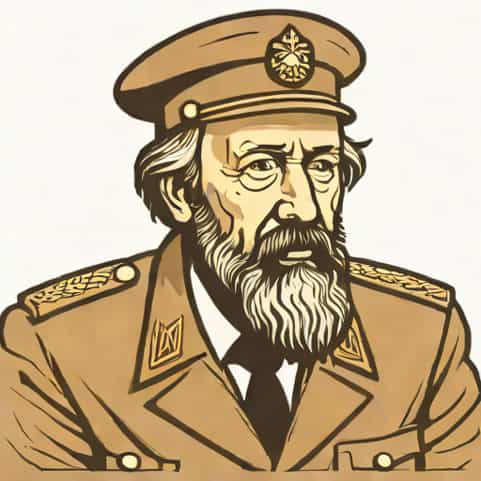
In the mid-1970s, one of the most famous writers and dissidents of the Soviet era faced a dramatic turning point in his life. Aleksandr Solzhenitsyn, celebrated worldwide for his powerful accounts of life under totalitarianism, was suddenly stripped of his citizenship and forced into exile. The moment when Solzhenitsyn was expelled from Russia shocked not only literary circles but also the global political landscape. His removal from his homeland highlighted the Soviet government’s determination to silence voices of dissent, yet it also ensured his works reached an even larger international audience. The expulsion was not merely a political act-it became a defining moment in the history of literature and human rights advocacy.
Background of Aleksandr Solzhenitsyn
Aleksandr Solzhenitsyn was born in 1918 and grew up in a turbulent Russia that had just undergone revolution and civil war. He served in the Red Army during World War II, but his military service ended abruptly when he was arrested for criticizing Joseph Stalin in private letters. Sentenced to years in prison and labor camps, Solzhenitsyn endured the harsh realities of the Soviet penal system. These experiences deeply influenced his writing, shaping him into a chronicler of oppression and resilience.
His early works, especiallyOne Day in the Life of Ivan Denisovich, gave readers a rare glimpse into the brutal conditions of Soviet labor camps. Although briefly approved by Soviet authorities during the Khrushchev thaw, his later works such asThe First CircleandCancer Wardwere banned. Still, they circulated in secret throughsamizdatnetworks and abroad, building his reputation as a fearless critic of Soviet repression.
The Path to Expulsion
By the early 1970s, Solzhenitsyn had become both a literary icon and a political threat in the eyes of the Soviet state. His monumental work,The Gulag Archipelago, documented in chilling detail the vast network of forced labor camps and the dehumanizing system of political imprisonment. The manuscript had to be smuggled out of the Soviet Union, and its publication in the West in 1973 caused a global sensation.
For the Soviet leadership, the international acclaim of this book was intolerable. It dismantled the carefully maintained image of the USSR as a just and progressive society. Instead, Solzhenitsyn presented the world with an unflinching record of cruelty, lies, and systemic abuse. The regime’s propaganda machine attacked him, labeling him a traitor, a liar, and even mentally unstable. Despite constant surveillance by the KGB, Solzhenitsyn refused to retreat or censor his views.
The Day of Expulsion
On February 12, 1974, Soviet authorities made their move. Solzhenitsyn was arrested, accused of treason, and within hours placed on a plane bound for West Germany. His Soviet citizenship was revoked, and he was warned never to return. For the Kremlin, this was a way to eliminate a dangerous dissident without turning him into a martyr through imprisonment or execution.
The expulsion of Solzhenitsyn from Russia drew worldwide attention. Western governments, human rights organizations, and intellectuals condemned the Soviet Union’s actions. Ironically, the attempt to silence him only amplified his voice. He was welcomed in Germany, then moved to Switzerland, and eventually settled in the United States, where he continued his literary and political work.
Life in Exile
Exile gave Solzhenitsyn new freedom to publish and speak openly, but it also came with challenges. He settled in Vermont, where he lived a reclusive life focused on writing. While in the West, he completed further volumes ofThe Gulag Archipelagoand delivered speeches on moral decline, spiritual emptiness, and the dangers of unchecked ideology. His sharp criticism extended not only to the Soviet Union but also to Western materialism and moral relativism, which surprised some of his supporters.
Solzhenitsyn became a global symbol of resistance to oppression, but he was never content to be a mere political figure. His goal remained literary and moral to preserve truth, expose lies, and encourage individuals to live with integrity. Even from exile, his influence on Russian intellectual life remained strong, with his works continuing to circulate secretly among readers inside the USSR.
Impact of His Expulsion
The decision to expel Solzhenitsyn had lasting consequences both for him and for the Soviet Union. It demonstrated the regime’s fear of literature as a weapon of truth. Far from silencing him, the expulsion turned him into an international symbol of courage. The West now had direct access to his writings, which became essential reading for understanding Soviet totalitarianism.
- Global AttentionHis expulsion made headlines worldwide and drew attention to the plight of other Soviet dissidents.
- Strengthened His VoiceLiving in exile gave him the ability to write and publish freely, spreading his message to millions.
- Symbol of Human RightsSolzhenitsyn’s case was cited by human rights activists as proof of Soviet abuses.
- Shift in Cultural DebateHis works helped shape Western understanding of authoritarian systems and the moral responsibility of individuals.
Return to Russia
In 1994, after two decades in exile, Solzhenitsyn returned to Russia following the collapse of the Soviet Union. His homecoming was emotional, symbolizing both personal vindication and the collapse of the system that had persecuted him. By then, his works had become part of the historical record, a crucial testimony to the suffering endured by millions under Soviet rule.
Although he remained critical of post-Soviet Russia’s political and cultural developments, Solzhenitsyn continued to advocate for moral renewal and national identity until his death in 2008. His return closed the circle of a life marked by exile, truth-telling, and resilience.
The story of Solzhenitsyn expelled from Russia is not just the story of one man but of the power of literature to challenge oppressive regimes. His forced exile highlighted the fragility of freedom under authoritarian rule, yet it also proved that ideas cannot be contained by borders. Through his writings, speeches, and moral authority, Solzhenitsyn left a legacy that transcends politics. His life serves as a reminder that truth, once spoken, continues to resonate across time and geography, no matter how determined the effort to silence it.