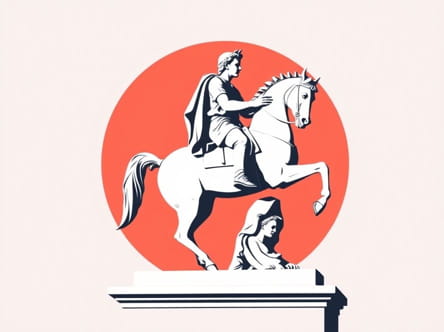
The Equestrian Statue of Marcus Aurelius is one of the most iconic surviving monuments of ancient Rome. Unlike many other bronze statues from antiquity, which were melted down for their metal, this statue was preserved for centuries, becoming a symbol of imperial power and philosophical rule. Located today in Rome, it depicts the Roman Emperor Marcus Aurelius seated calmly on a powerful horse, an image that speaks to his authority, wisdom, and leadership. This remarkable artwork stands as a testament to Roman artistry, imperial propaganda, and the philosophical legacy of a ruler often remembered more as a thinker than a warrior.
Historical Background
Marcus Aurelius ruled as Roman Emperor from 161 to 180 CE. He is widely regarded as one of the ‘Five Good Emperors’ and is especially known for his stoic philosophical writings, which are compiled in the famous workMeditations. His reign was marked by military conflicts along the empire’s northern frontiers, but also by efforts to govern wisely and ethically.
The Equestrian Statue of Marcus Aurelius is believed to have been cast around 175 CE, during or shortly after one of his military victories. Originally, it may have been part of a public monument to commemorate his leadership and victories. Though its original location is uncertain, some historians suggest it may have stood in the Roman Forum or near the Imperial Palace on the Palatine Hill.
Why the Statue Survived
The survival of this equestrian statue is largely due to a case of mistaken identity. In the Middle Ages, it was wrongly believed to depict Emperor Constantine, the first Roman emperor to convert to Christianity. Because of Constantine’s revered status in Christian tradition, the statue was spared from destruction during periods when other pagan symbols were dismantled or repurposed.
This fortunate error preserved one of the few surviving bronze statues from antiquity, allowing future generations to study and appreciate it not only for its artistic quality but also for its historical significance.
Artistic Features
The statue is made of gilded bronze and stands over 4 meters (13 feet) high. It features Marcus Aurelius mounted on a horse, with his right arm extended, as if addressing the crowd or offering clemency. The figure of the emperor is depicted with a calm, composed expression, emphasizing his philosophical nature and control as a ruler.
- Material: Cast in bronze and originally gilded, giving it a radiant appearance.
- Size: Overlife-sized to emphasize imperial grandeur and importance.
- Posture: The horse is shown in a walking stance with one hoof raised, and Marcus Aurelius sits without stirrups, demonstrating balance and mastery.
- Clothing: He wears a tunic and cloak, typical of Roman civilian dress, which reinforces his image as a philosopher-king rather than a military conqueror.
The design of the statue breaks from the traditional depictions of emperors as aggressive military leaders. Instead, Marcus Aurelius is shown as a serene and wise ruler, reflecting his reputation as a philosopher and ethical statesman.
Symbolism and Interpretation
The Equestrian Statue of Marcus Aurelius is rich with symbolic meaning. His outstretched hand is interpreted as a gesture of clemency or address, a mark of a ruler who governs with reason and justice. Unlike statues that celebrate raw military power, this one projects control, stability, and wisdom.
The horse itself is portrayed with realism and detail, representing strength and vitality. The absence of stirrups, which were not yet in use in Rome, highlights the skill required to ride and guide the horse. This artistic choice further glorifies Marcus Aurelius’s control and authority.
Renaissance Rediscovery
During the Renaissance, interest in ancient Roman culture and art experienced a revival. The statue of Marcus Aurelius became a model for artists and intellectuals who admired the harmony of classical art and the virtues of ancient philosophers.
In 1538, Pope Paul III had the statue moved to the Piazza del Campidoglio on Capitoline Hill in Rome. The relocation was part of a grand redesign of the square by Michelangelo, who created a new setting that highlighted the statue’s importance. Michelangelo’s design included a specially constructed pedestal and an architectural layout that emphasized symmetry and classical harmony.
The Capitoline Setting
The new setting elevated the status of the statue. Placed in the center of the square, it became a focal point of civic pride. Its placement on Capitoline Hill, one of the most sacred places in ancient Rome, reinforced its association with Roman greatness and continuity through the ages.
Conservation and Replica
In modern times, concerns about pollution and weathering led to efforts to protect the statue. In 1981, the original bronze statue was moved indoors to the Capitoline Museums to ensure its preservation. A faithful replica now stands in the piazza where the original once stood, allowing visitors to continue appreciating its grandeur in its historical setting.
The original statue has undergone detailed restoration, allowing experts to study its construction, materials, and historical wear. It is now displayed under controlled conditions, where it remains a key attraction for visitors and scholars alike.
Influence on Later Art
The Equestrian Statue of Marcus Aurelius has had a lasting influence on the art world. It inspired countless sculptures of leaders on horseback throughout European history, especially during the Renaissance and Baroque periods. Artists such as Donatello and Verrocchio created equestrian statues in Italy that drew directly from the Roman model.
Its enduring popularity also comes from the values it represents calm leadership, dignity, and the fusion of intellectual and political authority. Even today, the image of a leader on horseback often carries echoes of Marcus Aurelius’s iconic pose.
Philosophy and Legacy
Marcus Aurelius is remembered not just as a ruler but as one of the most prominent Stoic philosophers. His meditative writings, composed during military campaigns, reflect a life guided by logic, duty, and moral strength. The statue reflects these values in visual form, portraying him not in battle armor, but in a manner that emphasizes peaceful leadership and self-control.
The statue continues to be a powerful visual representation of the kind of leadership that values wisdom over brute force. In a world often shaped by power and ambition, the equestrian statue offers an image of authority tempered by philosophical depth.
The Equestrian Statue of Marcus Aurelius stands as a remarkable survivor of ancient Roman bronze artistry and a symbol of philosophical rulership. Through its design, preservation, and influence, it has transcended centuries to inspire admiration for both its artistic beauty and the values it represents. As one of the few original equestrian statues from antiquity, it connects the ancient world with the present and reminds us of a time when power was ideally paired with wisdom and self-restraint.