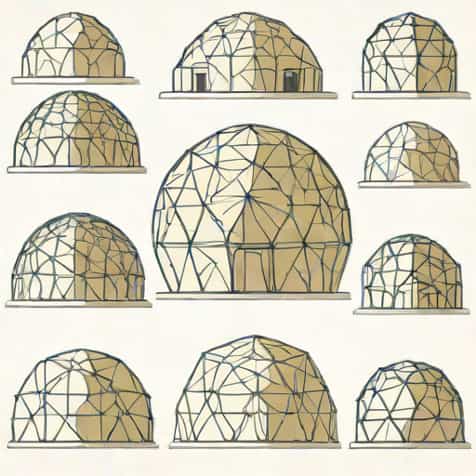
Geodesic domes have fascinated architects, engineers, and dreamers alike for decades. Known for their strength, efficiency, and futuristic appearance, these structures are not only visually striking but also highly practical. They use geometric patterns to distribute stress evenly, making them capable of withstanding heavy loads with minimal material. Over time, different types of geodesic domes have been developed, each offering unique design features and applications. From small backyard greenhouses to large-scale event centers, these domes demonstrate the versatility of geometry in architecture and design.
Understanding Geodesic Domes
A geodesic dome is a spherical or partial-spherical structure made up of interconnected triangles. The triangular framework provides exceptional strength, as each side distributes weight evenly across the structure. This design was popularized by Buckminster Fuller in the mid-20th century, who envisioned domes as a sustainable and efficient solution for housing and large enclosures. Today, the types of geodesic domes vary widely, offering options for residential, commercial, and recreational use.
Key Classifications of Geodesic Domes
The classification of geodesic domes is based on geometry, frequency, and application. Frequency refers to how many times the triangular faces of the dome are subdivided, which affects the dome’s smoothness and structural complexity. Additionally, domes can be categorized by shape, frame design, or intended function.
- 1V to 6V Frequency Domes
- Partial Geodesic Domes
- Full Sphere Domes
- Open and Closed Frame Domes
- Specialized Functional Domes
1V to 6V Frequency Domes
One of the most common ways to classify types of geodesic domes is by frequency. Frequency determines how smooth and rounded the dome looks. A low-frequency dome uses fewer triangles, while a high-frequency dome uses many smaller triangles, creating a more spherical appearance.
1V Frequency Domes
A 1V dome has the simplest structure, using large triangular panels to create the dome. These are easy to build and cost-effective, making them suitable for small structures such as playhouses, sheds, or temporary shelters. However, they lack the smoothness and roundness of higher-frequency domes.
2V and 3V Frequency Domes
These domes are more common for residential or medium-scale uses. A 2V dome is still relatively simple, while a 3V dome provides a smoother shape with greater structural stability. They are often used in small homes, greenhouses, or event tents.
4V to 6V Frequency Domes
These higher-frequency domes are much smoother and almost perfectly spherical. They are stronger, more durable, and capable of covering larger spans without internal supports. Because of their complexity, they are often used for large exhibition halls, sports arenas, and eco-friendly housing projects.
Partial Geodesic Domes
Partial domes, also called hemisphere domes, represent half of a sphere or less. They are commonly used for planetariums, theaters, and greenhouses. By cutting the dome in half, builders can create a structure that is easier to enter and use while retaining the structural benefits of a full geodesic design.
Full Sphere Domes
Full sphere geodesic domes encompass the entire globe-like structure. While rare in practical architecture due to their complexity, they serve as experimental projects or artistic installations. Their unique look often captures attention, and in some cases, they are used for radar enclosures, observatories, or large scientific equipment housings.
Open and Closed Frame Domes
Another way to categorize types of geodesic domes is based on the frame style. Some domes are designed with open frameworks, while others are fully enclosed with panels or coverings.
- Open Frame DomesThese are skeletal structures where only the triangular framework is visible. They are often used in gardens, art installations, or as decorative event structures.
- Closed Frame DomesThese have panels or fabric stretched over the framework to provide shelter. Closed domes are practical for housing, greenhouses, or event tents.
Specialized Functional Domes
Over time, geodesic domes have been adapted for specific functions. Their strength and efficiency make them suitable for various purposes, ranging from everyday use to large-scale projects.
Residential Domes
Some eco-friendly homes use geodesic domes as their main structure. These residential domes are energy-efficient, resistant to natural disasters, and easy to maintain. Their rounded design also promotes natural airflow, reducing the need for artificial heating or cooling.
Greenhouse Domes
Geodesic greenhouses are popular because their shape maximizes sunlight exposure while withstanding wind and snow. The triangular panels provide excellent insulation, making them ideal for sustainable farming and gardening.
Event Domes
Large-scale events often use temporary geodesic domes as pavilions or exhibition spaces. These domes can be quickly assembled, customized with different coverings, and provide open floor areas without internal supports, making them perfect for concerts, trade shows, and festivals.
Emergency and Military Domes
Because they are quick to assemble and highly durable, geodesic domes are sometimes used in disaster relief operations and military camps. Their ability to withstand extreme conditions makes them ideal for temporary housing in emergencies.
Advantages of Different Types
The variety of geodesic domes comes with several advantages that make them stand out from traditional architectural forms
- Lightweight yet extremely strong
- Efficient use of materials
- Energy-efficient with natural airflow and temperature regulation
- Scalable for small or large structures
- Unique aesthetic appeal
Different types of geodesic domes serve different needs, allowing builders and designers to choose the right structure for their project, whether it’s a small backyard installation or a massive sports arena.
Challenges and Considerations
While geodesic domes have many benefits, they also present challenges. High-frequency domes require complex calculations and precise construction techniques. Covering domes with traditional building materials can be difficult because of their unique shapes. Additionally, interior layouts may be challenging since curved walls limit the placement of furniture and partitions.
The types of geodesic domes-ranging from low-frequency 1V domes to complex 6V structures, from open frameworks to fully enclosed residential or greenhouse domes-highlight the flexibility and innovation of this architectural design. Each type has its strengths and applications, making geodesic domes a timeless solution for sustainable and efficient building. Whether used for homes, events, or scientific purposes, these domes continue to inspire architects and engineers, proving that geometry and design can work hand in hand to create structures that are both practical and visually stunning.