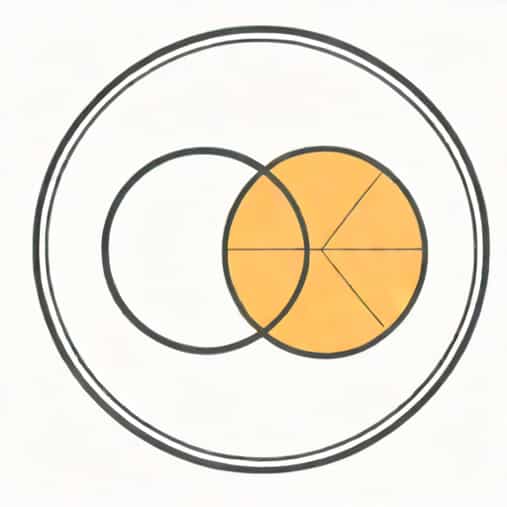
Learning mathematics often involves understanding relationships between numbers, and concepts like HCF (Highest Common Factor) and LCM (Lowest Common Multiple) are fundamental in number theory. One of the most effective ways to visualize these relationships is by using Venn diagrams. Venn diagrams provide a clear graphical representation of common factors and multiples, helping students and learners grasp the connection between different numbers. By arranging prime factors in overlapping circles, Venn diagrams make it easier to calculate HCF and LCM systematically. This topic will explain how to use Venn diagrams for HCF and LCM, step-by-step methods, practical examples, and tips for mastering these techniques.
Understanding HCF and LCM
Before learning how to use Venn diagrams, it is important to understand what HCF and LCM are. The HCF of two or more numbers is the largest number that divides all of them exactly. On the other hand, the LCM is the smallest number that is a multiple of all the numbers. Both concepts are essential for solving problems involving fractions, ratios, and multiples.
Highest Common Factor (HCF)
The HCF, also known as the greatest common divisor (GCD), identifies the biggest factor shared by two or more numbers. For example, the HCF of 12 and 18 is 6 because 6 is the largest number that divides both 12 and 18 without leaving a remainder.
Lowest Common Multiple (LCM)
The LCM finds the smallest number that is a multiple of the given numbers. Using the previous example, the LCM of 12 and 18 is 36 because 36 is the smallest number that both 12 and 18 divide exactly.
Introduction to Venn Diagrams
Venn diagrams are diagrams made of overlapping circles, each representing a set of elements. In the context of HCF and LCM, each circle represents the prime factors of a number. The overlapping region shows the common factors, which helps in identifying the HCF. The non-overlapping parts, combined with the common factors, assist in calculating the LCM. Using Venn diagrams is a visual and systematic method, especially helpful for students who struggle with abstract numerical methods.
How to Use Venn Diagrams for HCF
To find the HCF using a Venn diagram, follow these steps
- Step 1 Perform prime factorization of each number. Break down each number into its prime factors.
- Step 2 Draw overlapping circles. Each circle represents the prime factors of a number.
- Step 3 Place common prime factors in the overlapping section of the circles.
- Step 4 Place unique factors in the non-overlapping parts of the circles.
- Step 5 Multiply the common prime factors in the overlapping area to get the HCF.
For example, to find the HCF of 12 and 18 using a Venn diagram, first factorize the numbers 12 = 2 Ã 2 Ã 3 and 18 = 2 Ã 3 Ã 3. In the Venn diagram, the overlapping section will contain the common factors 2 and 3. Multiplying these gives HCF = 2 Ã 3 = 6.
How to Use Venn Diagrams for LCM
The Venn diagram can also be used to calculate the LCM of two or more numbers. The steps are similar to finding HCF, with one key difference
- Step 1 Perform prime factorization of each number.
- Step 2 Draw overlapping circles for each number’s prime factors.
- Step 3 Place common prime factors in the overlapping area.
- Step 4 Place the remaining factors in the non-overlapping sections.
- Step 5 Multiply all the factors present in the Venn diagram, including both overlapping and non-overlapping parts, to get the LCM.
Using the same example of 12 and 18, the prime factors are 12 = 2 Ã 2 Ã 3 and 18 = 2 Ã 3 Ã 3. In the Venn diagram, the overlapping area contains 2 Ã 3. The remaining factors, 2 from 12 and 3 from 18, are placed in non-overlapping sections. Multiplying all factors (2 Ã 3 Ã 2 Ã 3) results in LCM = 36.
Advantages of Using Venn Diagrams
Venn diagrams offer several benefits when working with HCF and LCM problems
- Visual clarity They provide a clear picture of common and unique factors.
- Systematic approach They reduce errors in complex calculations involving multiple numbers.
- Useful for multiple numbers Venn diagrams can handle more than two numbers efficiently, showing overlapping prime factors among all numbers.
- Educational benefits They help students understand the concept of factors and multiples intuitively.
Using Venn Diagrams for More Than Two Numbers
Venn diagrams are especially helpful when finding HCF and LCM for three or more numbers. Each additional number is represented by another circle, and the overlapping areas show the common prime factors among all numbers. Non-overlapping areas display unique factors for each number. Multiplying the factors in the overlapping area gives the HCF, while multiplying all factors (both overlapping and unique) provides the LCM. This method simplifies calculations and reduces confusion compared to traditional methods.
Practical Examples
Let’s look at a practical example involving three numbers 12, 18, and 24. The prime factorizations are 12 = 2 Ã 2 Ã 3, 18 = 2 Ã 3 Ã 3, and 24 = 2 Ã 2 Ã 2 Ã 3.
- Draw three overlapping circles for each number.
- Identify the common factors. All three numbers share 2 Ã 3.
- Place the remaining factors in their respective non-overlapping sections 12 has an extra 2, 18 has an extra 3, and 24 has two extra 2s.
- Multiply the overlapping factors for HCF HCF = 2 Ã 3 = 6.
- Multiply all factors in the diagram for LCM LCM = 2 Ã 3 Ã 2 Ã 3 Ã 2 = 72.
This method demonstrates how Venn diagrams simplify calculations for multiple numbers, providing both accuracy and clarity.
Tips for Mastering Venn Diagrams
To effectively use Venn diagrams for HCF and LCM, consider the following tips
- Always start with prime factorization to ensure accuracy.
- Label each circle clearly for each number being analyzed.
- Double-check overlapping and non-overlapping factors before multiplication.
- Practice with different sets of numbers to become confident in identifying common and unique factors quickly.
- Use color coding or highlighting to distinguish overlapping and unique areas for better visual understanding.
Using Venn diagrams for HCF and LCM provides a visual, systematic, and efficient way to solve number theory problems. By representing prime factors in overlapping circles, learners can easily identify common factors and calculate both the highest common factor and the lowest common multiple. This approach is particularly useful for handling multiple numbers and reduces the risk of errors compared to traditional calculation methods. With regular practice and understanding of prime factorization, Venn diagrams become a powerful tool for students and anyone working with factors and multiples. Mastering this method not only improves mathematical skills but also builds confidence in solving more complex problems involving HCF and LCM.