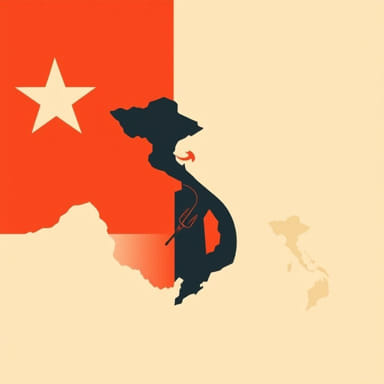
The history of Vietnam is deeply marked by the ideological and physical division between the communist North and the anti-communist South. This division, which lasted from the mid-1950s until the fall of Saigon in 1975, was rooted in colonial legacies, Cold War politics, and opposing visions for the country’s future. The conflict between North Vietnam and South Vietnam became one of the most defining and devastating chapters in Southeast Asian history. Understanding the causes, developments, and consequences of the division between the communist North and the capitalist South is essential to grasp the modern identity of Vietnam and its role in global affairs.
Origins of the Division
After centuries of Chinese domination and nearly a hundred years under French colonial rule, Vietnam was struggling for independence by the mid-20th century. During World War II, Japanese forces took control of the region, weakening the French hold on the colony. After Japan’s defeat in 1945, Vietnamese nationalists led by Ho Chi Minh declared independence and established the Democratic Republic of Vietnam in the North, guided by communist principles.
However, France aimed to restore its colonial authority, leading to the First Indochina War (1946-1954). The conflict ended with the Geneva Accords in 1954, which temporarily divided Vietnam at the 17th parallel. The agreement created a communist North under Ho Chi Minh and a non-communist South led initially by Emperor Bao Dai and later Prime Minister Ngo Dinh Diem, who became president of the Republic of Vietnam.
Communist Ideology in North Vietnam
North Vietnam was officially known as the Democratic Republic of Vietnam. Under Ho Chi Minh’s leadership, the government followed Marxist-Leninist principles. The North received military and economic support from the Soviet Union and the People’s Republic of China. It prioritized land reforms, collectivization, and class struggle to build a socialist state.
Ho Chi Minh and the Vietnamese Workers’ Party (later the Communist Party of Vietnam) believed in reunifying the country under communist rule. They saw the division as a temporary political solution, not a permanent separation. From the beginning, the North viewed the South’s government as illegitimate and dependent on foreign imperialists, particularly the United States.
Anti-Communist South Vietnam
South Vietnam, officially the Republic of Vietnam, took a different political path. President Ngo Dinh Diem established a staunchly anti-communist regime supported by the United States and other Western nations. The South aligned itself with capitalist principles, favored private property, and worked to suppress communist influence within its borders.
The South’s government faced criticism for corruption, authoritarianism, and religious discrimination, especially against the Buddhist majority. Despite receiving substantial U.S. military and financial aid, South Vietnam struggled with political instability, internal dissent, and a growing insurgency supported by the North.
The Viet Cong and Guerrilla Warfare
One of the most important elements in the North-South conflict was the National Liberation Front (NLF), commonly known as the Viet Cong. This communist guerrilla force operated in South Vietnam but was directed and supplied by the North. The Viet Cong used guerrilla tactics, sabotage, and political agitation to weaken the South Vietnamese government and win support from rural populations.
The presence of the Viet Cong blurred the line between North and South. It was not just a conventional war between two states it was also a civil war involving local support, ideological conversion, and underground networks of resistance and loyalty.
The Role of the Cold War
The Vietnam conflict was deeply influenced by the global Cold War between the United States and the Soviet Union. The division of Vietnam became a symbolic and strategic battleground between communism and capitalism. Each side received backing from their respective Cold War allies:
- North Vietnam: Supported by the USSR, China, and other communist nations
- South Vietnam: Backed by the United States, South Korea, Australia, and several Western countries
For the United States, preventing a communist takeover in South Vietnam was essential to the containment policy, which aimed to stop the spread of communism worldwide. This led to deep American involvement in the Vietnam War, with over half a million U.S. troops deployed at the war’s peak.
Escalation of the Vietnam War
The war escalated significantly after the Gulf of Tonkin incident in 1964, when U.S. Congress passed the Gulf of Tonkin Resolution, giving President Lyndon B. Johnson broad authority to increase military operations. What followed was a brutal and protracted conflict involving heavy bombing campaigns in both North and South Vietnam, as well as extensive ground combat.
Despite technological superiority and military power, the U.S. and South Vietnamese forces struggled to defeat the Viet Cong and North Vietnamese Army (NVA). The communist forces were deeply motivated, highly mobile, and well-supported by local populations in many areas.
Fall of South Vietnam and Unification
After years of intense fighting, rising American casualties, and growing anti-war sentiment in the U.S., American troops began withdrawing in the early 1970s. The Paris Peace Accords of 1973 temporarily halted fighting, but conflict resumed soon after.
In April 1975, North Vietnamese forces captured Saigon, the capital of South Vietnam, marking the end of the war. The event led to the official unification of Vietnam under communist rule. On July 2, 1976, the country was renamed the Socialist Republic of Vietnam, with its capital in Hanoi.
Consequences of Unification
After reunification, the new government began the process of transforming the South through socialist reforms. This included:
- Nationalization of private businesses
- Land collectivization programs
- Re-education camps for former South Vietnamese officials and soldiers
- Migration policies that moved Northern citizens to the South and vice versa
These policies met with mixed reactions and contributed to economic hardship and mass emigration, including the ‘boat people’ crisis, where hundreds of thousands of Vietnamese fled the country by sea to seek refuge abroad.
Legacy of the North-South Divide
Even decades after reunification, the effects of the communist North and non-communist South divide remain visible in Vietnam’s politics, economy, and culture. Northern Vietnam has traditionally held more political influence, while Southern Vietnam, particularly cities like Ho Chi Minh City (formerly Saigon), has emerged as a hub for economic development and international trade.
The war and division also left lasting psychological scars on families, veterans, and communities on both sides. Many Vietnamese still grapple with the trauma, memories, and divisions inherited from this painful chapter of their history.
Modern Vietnam and Reconciliation
Since the economic reforms known as Đổi Mới began in 1986, Vietnam has moved toward a more market-oriented economy, though it remains a one-party socialist state. Efforts have been made to reconcile historical differences and promote national unity. Education, public monuments, and official narratives emphasize shared identity and patriotism.
Today, younger generations grow up in a unified Vietnam with more opportunities for development and engagement with the global community. However, the story of the communist North and non-communist South remains a crucial part of Vietnam’s national memory.
The division of Vietnam into communist North and capitalist South defined the country’s 20th-century history. It was a conflict shaped by ideological struggle, colonial legacies, and global Cold War dynamics. The unification of the country in 1975 marked both an end and a beginning a closure to years of civil war and foreign intervention, and the start of a new chapter under a single, communist government. The legacy of that division still resonates in Vietnam’s political structure, cultural identity, and development path, making it a key theme in understanding the nation’s journey toward peace and progress.
#kebawah#